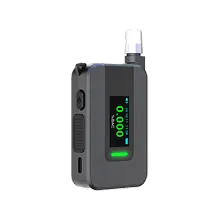
Promote safety and responsible alcohol screening with high-quality breath alcohol testers from Bharti Technologies. We supply reliable alcohol testing devices that deliver fast, accurate, and consistent BAC measurements for workplaces, transportation, construction, healthcare, law enforcement, and industrial sectors. Our range includes portable and professional-grade breath alcohol testers featuring advanced semiconductor and infrared (IR) sensor technology, user-friendly operation, and dependable performance. Whether you need routine employee screening or on-site alcohol testing, our solutions help organizations improve safety, maintain compliance, and create a secure working environment across the UAE.
 Category
A breath alcohol tester (commonly called a breathalyzer) is a device used to estimate the Blood Alcohol Concentration (BAC) of an individual by analyzing the alcohol in their exhaled breath. When a person drinks, alcohol is absorbed into the bloodstream and eventually travels to the lungs, where it is exhaled. Breath alcohol testers capture a breath sample and use internal sensors to detect alcohol molecules, correlating them to the approximate amount of alcohol present in the bloodstream.
Types of Sensors
Semiconductor Sensors: Most common in personal and portable testers. They react with alcohol molecules to generate an electrical current that indicates the BAC level.
Infrared (IR) Sensors: Used in law enforcement-grade devices. They measure the amount of infrared light absorbed by alcohol molecules, making them highly accurate and less prone to false readings.
The breath testers are very accurate for detection purposes, particularly the professional ones that utilize the fuel cells. They are less accurate compared to blood tests, however, since they work by estimating the BAC through measuring the alcohol content in breath, which is then divided by a constant value to estimate the blood content. The blood test involves directly measuring alcohol content in the bloodstream; hence, it is more accurate than the breath tester. Practically, when well calibrated, the breath tester can give almost identical readings as those of the blood alcohol level.
Battery life varies by model and usage, but most breath alcohol tests are designed to last a full day of frequent use. Devices can often withstand hundreds of tests on a full charge or with new batteries before needing to be replaced or recharged. Auto shut-off features and energy-efficient designs contribute to longer battery life during idle times. Rechargeable variants are frequently used in high-usage settings to prevent frequent battery changes. In actuality, operators may depend on reliable performance with regular daily use without having to worry about frequent power outages.
Hygiene is maintained through replaceable or disposable mouthpieces, which are changed after each use to prevent cross-contamination. Many devices also support non-contact or funnel-based testing, allowing users to blow from a short distance without direct contact. The tester itself does not retain breath residue, as air passes through the sensor chamber briefly and is vented out. Some models include one-way valves to prevent backflow. In practice, using fresh mouthpieces and basic cleaning ensures safe, hygienic testing even when the device is used by multiple people throughout the day.
The process of changing mouthpieces is intended to be fast and convenient, even in situations where the equipment will be frequently used. This is because most of the breath alcohol test instruments have mouthpieces that can simply be snapped or pushed into place without any need for tools. From a hygiene perspective, the mouthpieces can be disposed of after each user has tested his or her breath alcohol level, thereby minimizing the risk of cross-contamination.
It is not necessary to calibrate your device daily; however, this process is vital for achieving accuracy in the long term. Professional breath alcohol testing devices usually get recalibrated after six to twelve months, although this can depend on how often you use your device and according to the manufacturer’s guidelines. If the device is used frequently in a work setting, for example, it might be necessary to calibrate the device earlier to achieve accurate readings consistently.
Uncover compelling customer success stories that highlight the transformative impact of our solutions and services.



































































































































Solutions

Technology

Clients